

Vaginal Birth After a C-Section? Everything You Want to Know About VBAC
If you’ve already had a C-section and are now pregnant again, chances are you’ve also come across the term VBAC (Vaginal Birth After Cesarean) — the possibility of giving birth vaginally after a previous C-section. Maybe your doctor mentioned it, maybe you read about it in a mom group, or maybe the question has simply been sitting quietly in the back of your mind: Is this actually possible?
The short answer is: yes. And much more often than most women think.
For decades, the idea of “once a C-section, always a C-section” shaped the way birth after cesarean was viewed. But in recent years, medical recommendations and perspectives have changed significantly. Today, VBAC is no longer considered a dangerous or extremely rare exception, but a real possibility that many doctors now actively support in the right circumstances.
Of course, it’s not the right option for every situation or every mother, but the fact that your previous birth ended in a C-section does not automatically rule out the possibility of a vaginal birth.
Before we go any further, though, I want to make one thing clear: this article is not here to convince you of anything. Much more than that, it’s here to help you see your options more clearly and give you the kind of information that sometimes isn’t talked about enough — or that you may not feel comfortable asking your doctor about.

What Do the Numbers Show — and Who Should Even Consider a VBAC?
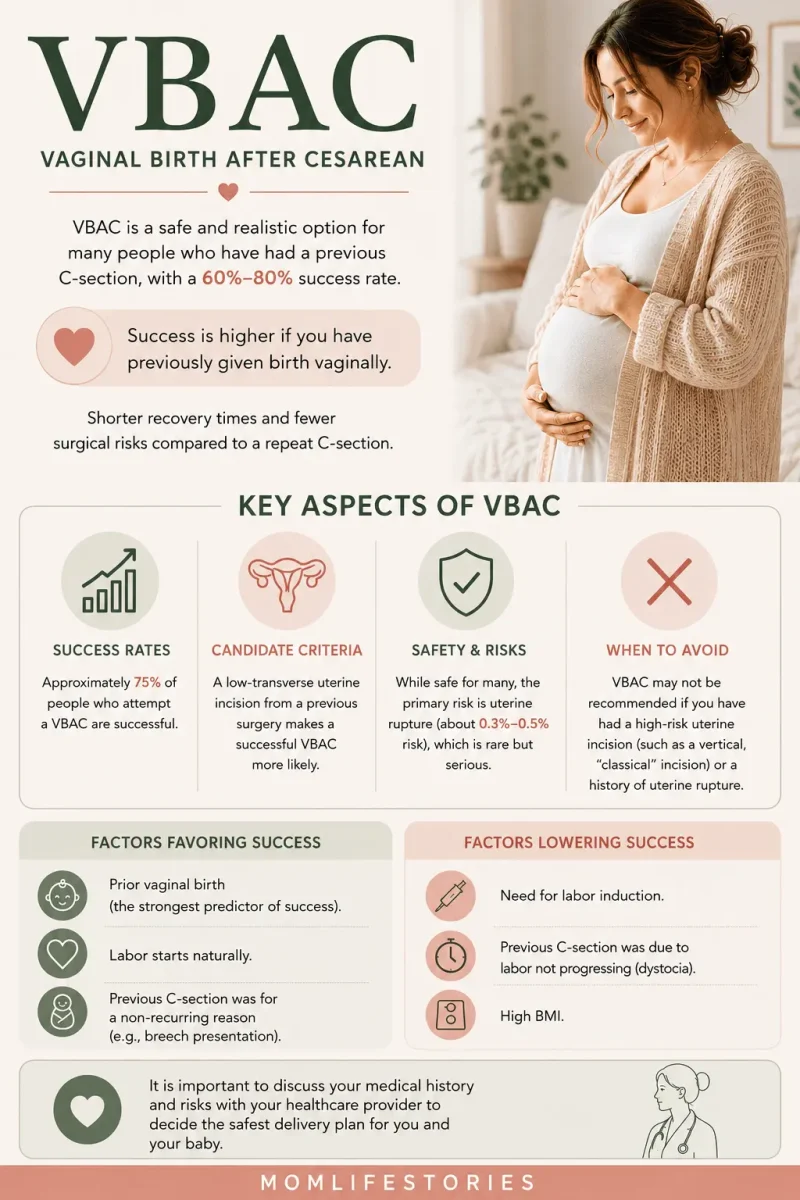
In the United States — where VBAC research is the most extensive — 60–80% of VBAC attempts end in a successful vaginal birth. That means the majority of women who choose to try for a VBAC do successfully give birth vaginally. One of the biggest factors that determines whether you may be a good candidate for a VBAC is the reason behind your previous C-section.
For example, if the surgery was necessary because your baby was breech, or because of a situation that is unlikely to happen again, the chances are generally more favorable. On the other hand, if the first birth involved concerns about the baby’s size and the mother’s pelvis, that’s something worth evaluating again — but it does not automatically rule out the possibility of a VBAC. The amount of time between births also matters.
In most cases, 18–24 months or longer is considered the ideal interval. The condition of the uterine scar is another important factor, and today’s ultrasound technology can give doctors a much clearer picture than it could in the past. For many women, the biggest fear surrounding VBAC is the risk of uterine rupture.
But it’s important to look at this realistically as well: in properly selected cases, the risk is less than 1%. That doesn’t mean the risk is zero — but it’s also far from the terrifying scenario it is sometimes made out to be.
The Unspoken Emotions Quietly Hiding in the Background
Many women struggle not only with whether a VBAC is possible, but also with why they want one in the first place. If your previous birth ended with being rushed into surgery, or if you never fully understood everything that happened to you, it can leave an emotional mark behind. Not necessarily trauma — but certainly unanswered questions.
The idea of a “healing birth” is often connected to exactly this. Not because your previous birth was a failure, and not because you have anything to prove. Sometimes, it’s simply about feeling like you have a chance to regain a sense of control over your own birth experience. For many women, VBAC (Vaginal Birth After Cesarean) is not only a physical experience, but an emotional one as well. And that is completely valid.
That’s why it can be incredibly helpful to talk not only about the medical side of VBAC, but also about your emotions surrounding your previous birth — whether with your doctor, a doula, or a childbirth educator.
👉 This powerful video explores the reality of VBAC, birth trauma, and the emotional journey many mothers face after an unexpected or difficult birth experience. It offers honest insight, support, and evidence-based information for women trying to understand their options and regain confidence in their next birth experience.
The Supportive Environment You Simply Can’t Ignore
For a successful VBAC, it’s often not enough for your doctor to simply “allow” it. There’s a huge difference between a provider who merely tolerates the idea of VBAC and one who genuinely believes in it and actively supports the process. And that difference can absolutely affect both the birth experience and the outcome.
That’s why it’s worth asking your future provider or hospital about their experience with VBACs. How many VBAC attempts have they supported in the past year? What are their success rates?
These are not rude or distrustful questions — they are part of making informed decisions about your own birth experience.
And if a hospital or maternity unit does not truly support VBAC in the first place, that matters too.
You have the right to choose a care team and birth environment that aligns with your needs and values.
The role of a doula should not be underestimated either.
Continuous labor support has been shown to increase the chances of a successful VBAC (Vaginal Birth After Cesarean) as well. A skilled doula can help you manage labor, suggest helpful positions and movement, and support you emotionally during the moments when it becomes hardest to stay focused and grounded.
👉 If you’re preparing for birth, the right movement and labor positions can make a huge difference. From squatting and birth ball techniques to partner-supported positions, doulas often recommend simple ways to help labor progress more comfortably and naturally. Discover the labor positions doulas swear by to ease pain, support baby’s descent, and help you feel more confident during labor.👉 Easier Labor? These Are the Labor Positions Doulas Swear By

If Birth Still Ends in the Operating Room — The Possibility of a C-Section
Preparing for a VBAC (Vaginal Birth After Cesarean) does not mean shutting out every other possible outcome or only allowing yourself to imagine one type of birth. In fact, women who prepare for VBAC in the most informed and balanced way are often the ones who also ask themselves an important question: What happens if my birth still ends in a C-section?
More and more hospitals are now embracing the idea of a more mother-centered C-section experience.This does not mean a completely different surgery — a C-section is still a major abdominal operation. The difference is often in the way the birth experience itself is approached.
In many places, mothers may be offered options such as immediate skin-to-skin contact, lowering the surgical drape, or being able to witness the moment their baby is born. At first, these details may seem small. But emotionally, they can make a profound difference in how a birth is experienced and remembered.
There is a huge emotional difference between feeling like “this suddenly happened to me” and feeling like “Iunderstood what was happening, I was present in the moment, and I had a voice in my experience.” In reality, VBAC is not just a single decision — it’s an entire process. From gathering information and asking difficult questions, to making choices and ultimately experiencing your baby’s birth day — whatever path that birth may take.
Today, in 2026, women have access to far more knowledge, support, and options than ever before. Enough to make this journey feel like it truly belongs to you — not just to hospital protocols or “the way things are usually done.” Because in the end, the most important thing is not how you give birth — but whether the experience feels like your own story.
👉 Even with the best preparation, birth does not always go as planned. This honest article explores birth trauma, unexpected C-sections, and the emotional side of feeling unheard, powerless, or disappointed after delivery — while helping mothers process their experience with compassion and understanding. 👉Birth Trauma: When Your Birth Didn’t Go As Planned
👉If you’d like to walk this journey feeling more prepared, more confident, and a little less worried, visit the Little Lifesavers page and explore our free downloadable resources. They’ll help you stay organized, plan ahead, and create the kind of calm and clarity you need most right now.
👉And if birth stories, real experiences, and the emotional journey of childbirth matter to you, you’ll find more honest reflections and preparation in our Childbirth section.