

Mental Load: Why Are So Many Working Moms Burned Out—And What Can You Do About It?

Mental load is one of the most invisible—and exhausting—parts of motherhood. You probably know that feeling when you’re about to take your first sip of coffee, but your mind is already racing through the day’s endless to-do list: doctor’s appointments, grocery shopping, packing lunches, buying new shoes the kids have outgrown, after-school activities, birthday gifts, and keeping track of everyone’s schedule. Before your day has even begun, your brain is already hours ahead.
From the outside, everything may look perfectly under control. But inside, your mind never truly switches off. Mental load isn’t about washing dishes or folding laundry—it’s the invisible work of planning, remembering, organizing, and anticipating everything that keeps a family running. In many cases, it’s not the physical tasks that leave moms exhausted—it’s the fact that their minds rarely get a real break.

A Personal Story
I know what mental load feels like because I’ve lived it myself.
When we were newly married, we invested all our savings into moving from an apartment to our first family home. My husband was working day and night, while I was pregnant with our second baby and caring for our energetic three-year-old daughter.
At the same time, our new house was being renovated inside and out, the yard looked more like a jungle than a garden, and I somehow became the person coordinating contractors, answering questions, and making sure everything kept moving forward.
Meanwhile, I was navigating the challenges of my third trimester and trying to create a place where my little girl would feel safe and at home again. It was one of the hardest seasons of my life—both physically and mentally. I became so overwhelmed that I realized I wasn’t even enjoying what we’d worked so hard to achieve. Some days, I found myself missing the simplicity of my life before marriage and children.

As the years passed, the challenges changed, but the mental load didn’t disappear. School assignments, activities, doctor’s appointments, birthdays, shopping lists, family schedules—I noticed that although my husband and I shared many of the visible tasks, I was still the one carrying the invisible responsibility of remembering everything.
Sometimes it even felt like I was reminding him about things he didn’t realize needed to be remembered in the first place. Everything started to change when I finally found my voice. Sometimes I explained calmly, other times less calmly, that I was overwhelmed and needed everyone to share the responsibility—not just the chores.
We divided tasks more intentionally, involved the kids in small household jobs, protected time to relax together on weekends, and I finally started making regular time for myself. The biggest lesson I learned was this: sharing tasks helps, but sharing responsibility is what truly lightens the mental load.

When Your Mind Is Running the Entire Family
Many working moms—and perhaps you as well—feel like they’re juggling the roles of project manager, personal assistant, logistics coordinator, and problem solver all at once. Even during an important meeting at work, you may catch yourself wondering whether you’re out of diapers, if daycare or preschool has been paid for, when it’s time to schedule the next dentist appointment, or who will take your child to soccer practice.
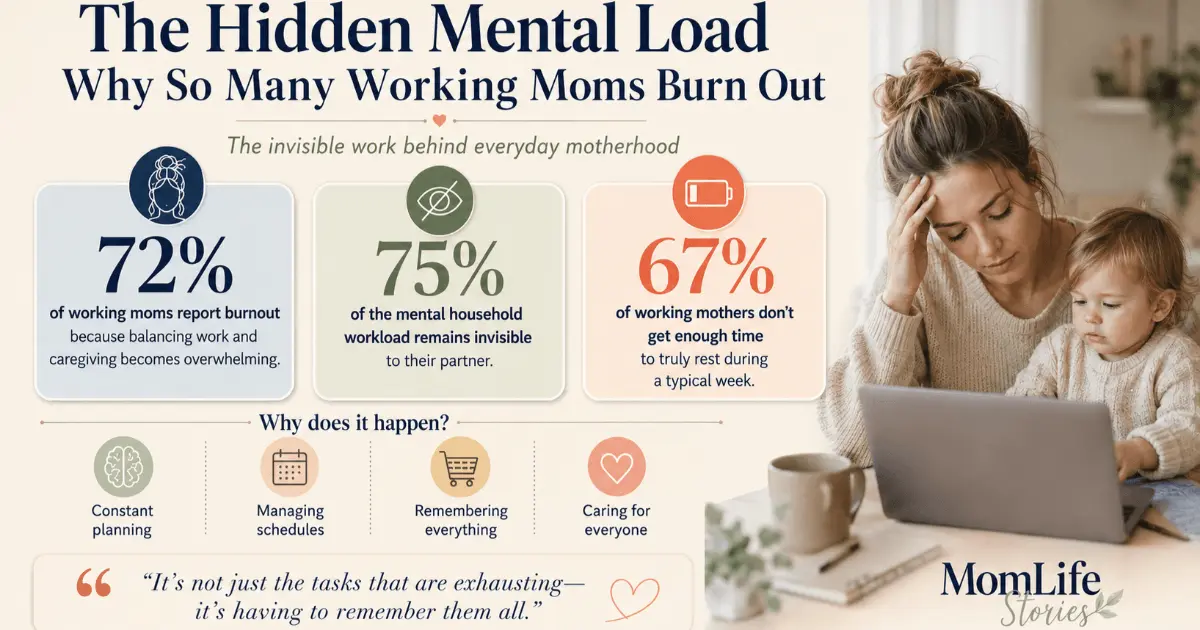
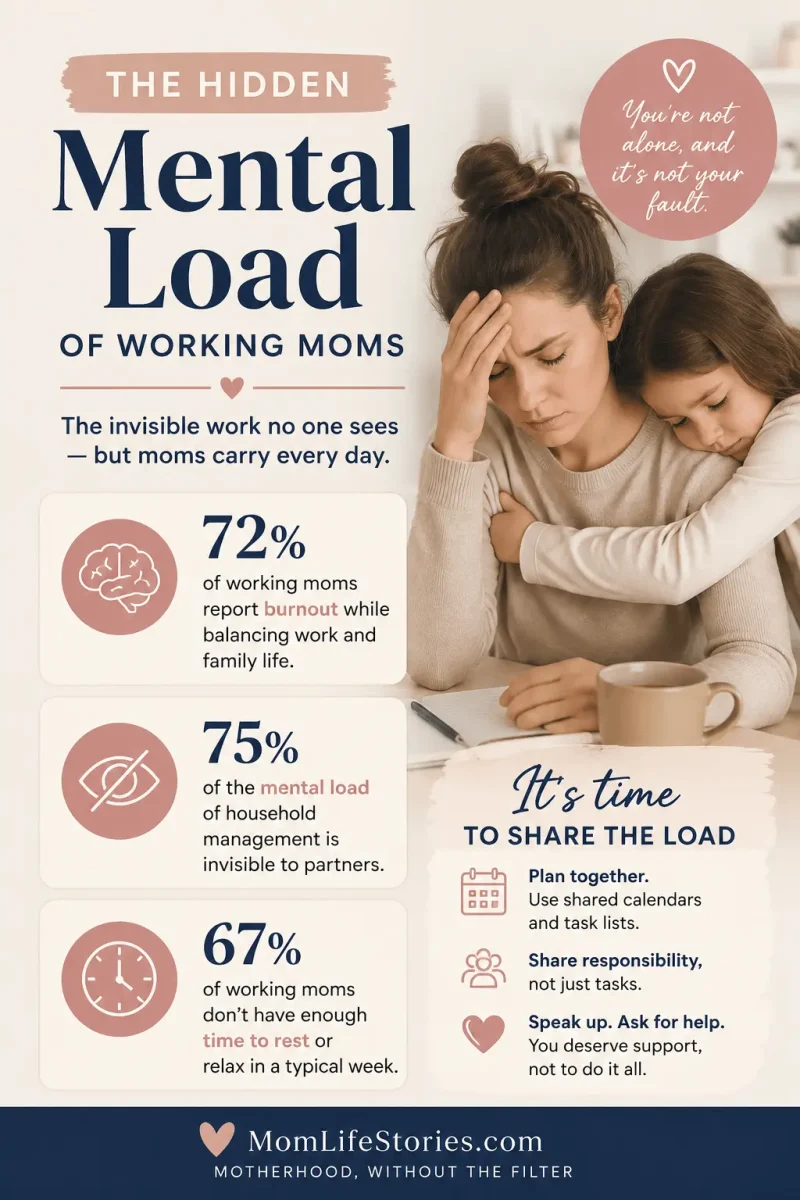
It’s this constant state of mental alertness that becomes truly exhausting over time. It’s no surprise, then, that research shows 72% of working mothers report experiencing burnout as they struggle to balance work and family life. Another study found that the mental side of household management remains largely invisible to partners in 75% of families, even though many genuinely believe the responsibilities are shared equally.
On top of that, 67% of working moms say they don’t have enough time for real rest or relaxation during a typical week. These aren’t just statistics—they reflect a reality that affects millions of families every day. From the outside, everything seems to run smoothly: the kids arrive at daycare or school on time, dinner is on the table, birthday gifts are bought before the party.
What most people don’t see is the constant planning, organizing, remembering, and anticipating happening behind the scenes—the invisible work that quietly drains your energy day after day.
When “I’ll Help” Isn’t Enough
One of the biggest challenges of mental load is that it’s often not about doing the tasks—it’s about being the one who has to remember them in the first place. If you’re the person keeping track of school picture day, renewing your child’s passport, buying the next pair of shoes, or scheduling doctor’s appointments, while your partner only steps in after you’ve asked, then you’re carrying the responsibility of managing the entire family system.
That’s far more exhausting than it looks from the outside. It’s rarely the dishes or the grocery shopping that wear you down the most—it’s the constant planning, remembering, anticipating, and coordinating that never seems to stop. This invisible work doesn’t end after work, on weekends, or even during vacations. In fact, it’s often strongest when everyone else is relaxing, while you’re already mentally organizing the week ahead.

The Solution Isn’t Better Organization
Many moms believe the answer is a more detailed to-do list or a better schedule. But the truth is, mental load doesn’t decrease simply because you become more organized. It begins to ease when the responsibility itself is shared—not just the individual tasks.
A few simple changes can make a big difference:
Protect at least two hours of personal time every week. Make sure your family respects that time, and give yourself permission to truly enjoy it—without guilt.
If you’re feeling overwhelmed, speak up. Sometimes the people around us simply don’t realize how much we’re carrying. The first step toward change is letting them know you need support.
There’s another simple exercise that can be a real eye-opener for many couples. For one week, each of you should write down everything you keep track of mentally every day—not just the visible tasks, but also the reminders, planning, anticipating, and organizing that happen behind the scenes. When you compare your lists, the difference in mental load often becomes obvious without either of you having to explain it.

Clear Communication and Outside Support Can Make a Big Difference
Sometimes just ten minutes of planning together each week can make a remarkable difference. Talking through the upcoming days in advance helps reduce constant reminders, last-minute stress, and misunderstandings. It doesn’t just make family life easier—it can also strengthen your relationship.
If you’re raising your child on your own, or if your partner isn’t able to share the planning responsibilities right now, there are still ways to lighten your mental load. Automatic bill payments, recurring reminders on your phone, and shared digital shopping lists can take dozens of small decisions off your mind.

And don’t feel guilty about asking for help when you need it. Hiring a babysitter, bringing in a cleaner, or ordering prepared meals isn’t a sign of failure—it’s a conscious choice to protect your time and energy. Sometimes the greatest relief comes simply from not having to carry every detail in your head all by yourself.
👉 If you feel like the demands of everyday life are draining all your energy, it’s worth making time to recharge yourself, too. Even small, intentional changes can help you regain more energy—not only for your family, but for yourself as well. 👉 Healthy Mom Lifestyle: Finding Balance, Energy, and Joy in Motherhood

The Goal Is Shared Responsibility
Imagine starting the same morning knowing that half of the family’s responsibilities are no longer living only in your head. You don’t need to build the perfect system overnight. A shared to-do list, a short weekly planning session, or simply giving one person full ownership of a specific area can already make a meaningful difference.
Mental load rarely disappears overnight. But once it becomes visible, it stops being an invisible feeling and becomes a challenge that can be solved together. The goal is shared responsibility—making sure that the work of keeping the family running no longer rests on one person’s mind and shoulders alone, but becomes something you truly carry together.

Frequently Asked Questions About Mental Load
👉If you’d like to walk this journey feeling more prepared, more confident, and a little less worried, visit the Little Lifesavers page and explore our free downloadable resources. They’ll help you stay organized, plan ahead, and create the kind of calm and clarity you need most right now.
👉 And if you’re looking for a place that brings all of this together — real motherhood stories, everyday struggles, and gentle support — you’ll always find it on MomLifeStories.