

6+1 Surprising Things About Childbirth to Expect

You might feel like you’ve heard enough birth stories — and still, not everything about childbirth feels clear. We’ve gathered what’s worth knowing, but your own doctor or doula will always be your most reliable guide.
Childbirth is rarely exactly what you imagine. You picture it, prepare for it, try to understand what will happen — and yet, when the moment comes, things often unfold differently. You hear stories, advice, sometimes even frightening experiences — but when you’re actually in the delivery room, you realize that some parts are simply hard to put into words.
Many believe they can prepare for every possibility, but the truth is, childbirth always brings unexpected moments. And often, it’s these small, less talked-about details that would help the most — if we knew them in advance.

1.) I’ve never felt pain like this before.
When I asked others during prenatal classes — the doctors, my mom, and the women in my family — what childbirth feels like, everyone said something different. Some compared it to intense menstrual cramps, others to having a tooth pulled — the entire pain scale came up in those conversations. Looking back, one of my coworkers — now a grandmother — described it most accurately: “Childbirth is exactly like childbirth.”
And it’s true. Childbirth can’t really be compared to anything else. Especially not to what we see in movies, where the main character lets out a couple of soft groans, breaks a light sweat, and then smiles peacefully between contractions. The pain relief made me feel slightly foggy, and time seemed to slow down. A flood of emotions moved through me all at once — panic, desperation, worry that everything would be okay. And in that moment, the main thought wasn’t “I can’t wait to meet my baby,” but rather: “I just want this to be over.”
When my daughter was finally born, it felt like everything inside me had been torn apart — not just the world, but me too, from the waist down. It started as a natural birth, I labored for 15 hours, and in the end, it still turned into a C-section. And yet, there was that moment too — that quiet, overwhelming smile. When I finally understood what the doctor had already said three times into my ear: “Your baby girl is here.”
👉If your childbirth experience ended in a C-section, recovery can feel like a completely new chapter — physically and emotionally. There are things no one really prepares you for. 👉The Reality of C-Section Recovery – What No One Ever Told You
2.) It’s not just about epidurals
You don’t have to silently endure even manageable pain, and it’s also true that certain baby positions or emotional factors can make childbirth feel especially intense and overwhelming. Massage, a warm bath or shower, and heat packs — even combined with pure, high-quality essential oils — can often bring real relief. These are natural options with no added risks or side effects during childbirth.
Medication-based pain relief is different. Epidurals can limit movement during childbirth, and in some cases, they may weaken contractions, slow down labor, or make pushing more difficult. They can also affect a newborn’s alertness and willingness to feed in the first hours — and they don’t always work as expected.
At the same time, during long, exhausting labor or when contractions are intensified with oxytocin, a well-timed epidural during childbirth can help prevent maternal exhaustion and a C-section. That’s why it’s often best seen as a last option — something to keep in reserve if nothing else brings relief. One of the most surprising sensations during childbirth is the sudden feeling that you need to go to the bathroom — this is exactly what pushing contractions can feel like.
Many are also caught off guard by the fact that childbirth doesn’t end when the baby is born. Delivering the placenta is still part of the process, even if it’s usually quicker. And there’s something else we don’t talk about enough: during childbirth, there often isn’t much talking at all. You turn inward, focus, and quietly work with your body.
3.) A father is not a helper — he is an active participant in childbirth
In the past, women were expected to adapt, comply, and follow, while men were seen as the ones in control — emotionally distant, focused on logic, responsible for providing and protecting. When fathers first began to be present during childbirth, these unspoken roles were still deeply ingrained.
Today, more couples are moving toward a more equal, flexible, and emotionally connected dynamic. A space where women have agency and decision-making power — and where men are allowed to feel, to connect, and to be present with both their partner and their child.

And yet, during childbirth, many men still fall back into old roles. It’s not uncommon for mothers to expect fathers to take control in the hospital setting, to advocate, or even to provide professional-level support during labor.
While these expectations can be understandable, placing the full responsibility of the childbirth experience on your partner is a heavy burden. Childbirth is his experience too.
He has just as much right to his own emotional process as the mother does. Calling a father’s presence “help” is only true in the same sense that a partner’s presence during intimacy is “help” — it’s not external support, but shared participation.
Bringing a child into the world — and raising that child — is a shared experience from the very beginning.
Each parent lives it in their own way, but ideally, both are committed to supporting each other’s needs and emotions as much as they can.
👉Having your partner present during childbirth can be powerful — but it’s not always as simple as it sounds. Sometimes, support can quietly turn into pressure. 👉Partner-Supported Birth – A Shared Experience or Too Much Pressure?

4.) The baby is not a passive participant in the process of childbirth
A baby is not simply going through childbirth — even before birth, they are a feeling, responsive human being, actively involved in the process. Childbirth is not determined by timing, luck, or hospital protocols, but much more by when the baby is ready to begin their first great task.
Contractions don’t just prepare the body physically — they support both body and mind in the transition into the world. Passing through the birth canal is an intense, almost cathartic process, one that often ends in a powerful sense of completion. In comparison, a C-section can feel like a more sudden, less predictable transition for the baby. That’s why babies born this way often need even more gentle welcoming, familiar voices, and early, continuous closeness with their mother.
A dedicated, heart-led birth professional — whether a doctor, midwife, or doula — often begins connecting with the baby already during pregnancy and labor. They speak to the baby, stay present, and help the mother stay connected throughout childbirth, then receive the newborn with care and, when possible, place them into the mother’s arms as soon as they can.

5.) The golden hour after childbirth
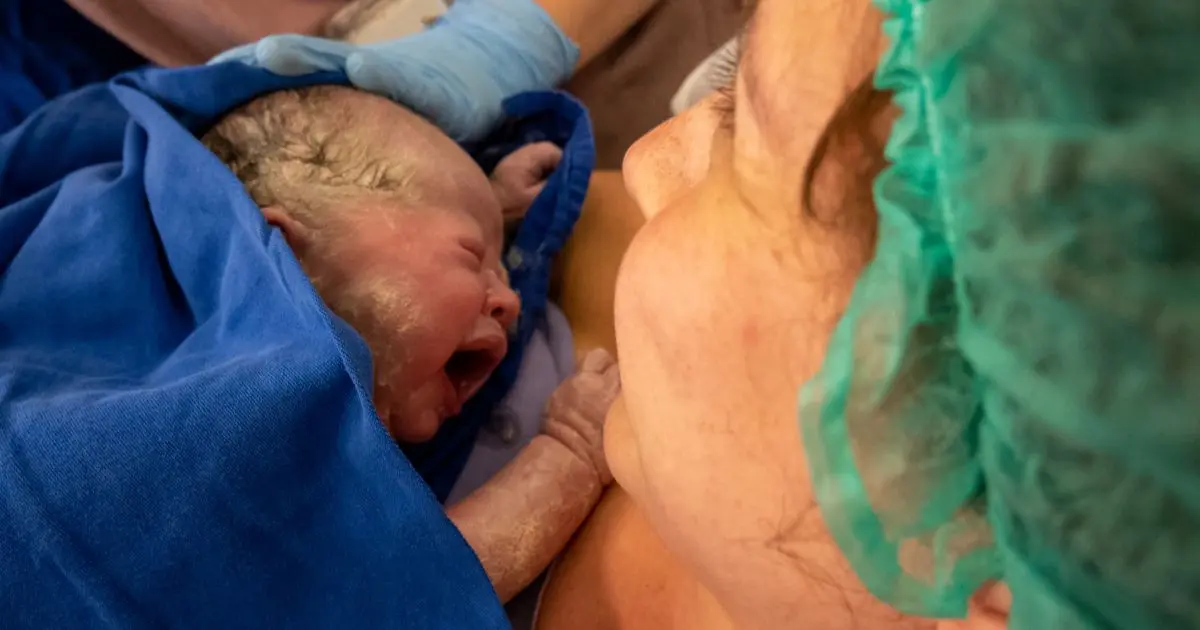
Even a childbirth experience that unfolds very differently from what you planned can feel softer, more grounded, if your baby is placed on your bare skin immediately — and can stay there for at least the first 1–1.5 hours. That first skin-to-skin contact can change everything. If this isn’t possible, the next best option is for the newborn to rest on the father’s chest in skin-to-skin contact, until they can finally be held by their mother.
If no medication was used during labor, babies are often alert, strong, and naturally drawn to their parents. In many cases, they are able to move toward the breast on their own and latch effectively. Those first drops of colostrum are incredibly valuable for their immune system, and this early moment reinforces something important for both of you: you can work together in breastfeeding.
When the first hours after childbirth are very different from this natural process — and the baby is separated from both parents — it can be a deep source of stress for all three of you. It may affect bonding, reduce the chances of successful breastfeeding, and later require additional support to process what was missed.
That’s why it matters where your childbirth takes place. Immediate and continuous skin-to-skin contact for at least the first hour should not be a special request — but a standard practice that every healthy mother and baby receive.

6.) Support during postpartum matters just as much as during childbirth
From photos of celebrity moms, it’s easy to assume that women leave the hospital looking almost the same as before pregnancy. The reality after childbirth is very different. Even days later, the uterus has not fully returned to its original size, the placenta site is still a healing wound, and the internal organs are still shifting back into place.
If you’ve had a perineal tear or a C-section, movement can be limited for a while — but even without complications, your body needs rest, time, and a gentler pace for weeks. There’s a reason this period is called postpartum recovery. After your first baby, emotional support is just as important — it helps build confidence in your new role.
With more children, practical help becomes essential: caring for older siblings, cooking, cleaning, and managing everyday tasks. But not all help feels supportive. Real support doesn’t criticize — it lightens your load. A relative who comments on the mess while interfering with your baby care or questioning your choices can do more harm than good.
+1.) Your body changes — and that’s a natural part of childbirth
One of the hardest parts of the childbirth experience can be that first moment when you look at yourself in the mirror. Your body has changed. Your stomach, your breasts, your shape — they don’t look the same as before. Breastfeeding can also feel physically demanding, and it often takes time to feel at home in your body again after childbirth.
But these changes are not permanent, and they don’t define who you are. Your body is healing, adjusting, and finding its way back — in its own time. And in the meantime, it has done something truly extraordinary. And maybe most importantly: your baby doesn’t care how your body looks. What matters is that you’re there — that they can see you, feel you, and be close to you. That’s what truly matters.
Your childbirth may not unfold the way you imagined — but every moment of it will still be your story.
👉If you’d like to walk this journey feeling more prepared, more confident, and a little less worried, visit the Little Lifesavers page and explore our free downloadable resources. They’ll help you stay organized, plan ahead, and create the kind of calm and clarity you need most right now.
👉And if birth stories, real experiences, and the emotional journey of childbirth matter to you, you’ll find more honest reflections and preparation in our Childbirth section.