

Mom guilt: Not Loving Every Moment Doesn’t Make You a Bad Mom
A gentle look at mom guilt, boundaries, and motherhood identity
Do you ever wake up already feeling tense, knowing that the moment you step out of the bedroom, your child will want to play? I do. And while part of me wants to be fully present, my mind often jumps straight to everything else waiting for me that day — the chores, the work, the endless mental to-do list that starts running before I’ve even had my first sip of coffee.
Alongside that tension, another feeling quietly shows up: mom guilt. The kind we rarely say out loud.
This story is mine. It’s about what it feels like when you don’t love every single moment of motherhood — and the shame that can come with admitting that. I spend a lot of time with my child. We play together often. And yet, instead of feeling energized, I’m sometimes left feeling drained. As if no matter how much I give, it’s never quite enough. And somehow, there’s less and less left of me.
Mom guilt follows me through my days. It’s there while I’m playing, and it’s there when I secretly wish I could say no. I catch myself wondering if something is wrong with me. After all, a good mom is supposed to enjoy playing with her child… right?
When Playing Stops Feeling Joyful and Turns Into Inner Tension
For a long time, I thought something was wrong with me — because this isn’t an easy feeling to say out loud. And yet, it’s there almost every day: no matter how much I play with my child, it somehow never feels like enough. I hear it again and again: “Mom, play with me.” And I do. I play and play and play — while quietly realizing that there’s less and less time left for me.
Mom guilt doesn’t come from a lack of love. Quite the opposite. It comes from not feeling what I think I’m supposed to feel. From noticing that playing together doesn’t always energize me — and from feeling ashamed of that truth. Sometimes the tension shows up before the day even begins, because I already know that the moment I step into the room, the needs will come rushing in all at once.
When I want to say no, fear often stops me. My child’s big emotions, the tears, the frustration — and the immediate thought that follows: “I’m hurting them by setting this boundary.” In those moments, mom guilt tightens its grip, and I often end up giving up my own limits. What looks like a simple boundary issue from the outside is something much deeper on the inside.
This isn’t really about playing. It’s about how little space I allow for my own needs, and how hard it feels to believe that my needs matter too.
👉If this feels familiar, you might also want to read The Perfect Mother — and What Lies Beneath.
It explores where the pressure to be endlessly patient, present, and selfless really comes from — and what happens when we quietly try to live up to an impossible ideal. Because often, the guilt we carry isn’t about our children at all, but about the expectations we’ve absorbed over time.
The Role of Special Time — and the Misunderstandings Around It
Special time is that regular one-on-one time when my child gets to choose the activity, and the goal isn’t teaching or improving anything, but being fully and undividedly present together. Over time, I’ve noticed that even ten minutes a day can make a real difference — it helps lower tension and gives my child a sense of safety and connection. Special time can also make boundaries easier to accept. It doesn’t require long explanations or justification. Often, one honest sentence is enough:
“For the next 20 minutes, I’m playing only with you and giving you my full attention. After that, I need to vacuum and tidy up. If you’d like, you can help — and later, we can be together again.”
This approach has gradually softened my mom guilt, because it isn’t built on all-day self-sacrifice. Instead, it shifts the focus to quality over quantity. At the same time, it was important for me to recognize that special time isn’t a magic solution. It doesn’t automatically make playing enjoyable, and it doesn’t erase my need for space — for moments when I can breathe and be myself.
That realization felt deeply freeing. Because the goal isn’t to love every moment of play — it’s to stay connected without disappearing from the relationship.
👉If this resonates with you, you might also enjoy Healthy Mom Lifestyle: Finding Balance, Energy, and Joy in Motherhood. It’s about what happens when we stop trying to give endlessly, and instead start looking for small, realistic ways to care for ourselves — not as a luxury, but as a foundation. Because staying connected to our children becomes easier when we’re not running on empty.
When “Play” Starts to Feel Like Wasted Time
Through conversations with friends and other moms, I slowly uncovered a deeply rooted belief I’ve been carrying for years: to me, play often feels like wasted time. It’s a message I absorbed in childhood and carried with me into adulthood — the idea that valuable time should be spent learning, achieving, or doing something productive.
As a child, I played a lot with my dad. But I don’t remember my mom sitting down with me and simply playing, without an agenda. As I grew older, more and more responsibility landed on my shoulders. I had to take care of my sibling, and somewhere along the way, I learned that other people’s needs came before my own.
That pattern still shows up in my life today. I struggle to give myself permission to rest. To play. Or even to pause for a moment. To believe that being “good enough” is actually enough. It often feels like there’s always something more important, more useful, more urgent waiting for me.
This inner conflict often turns into mom guilt. Not only because I don’t enjoy playing all the time, but because I constantly compare myself to others. Especially when I see how easily and joyfully my partner plays with our child. That comparison doesn’t motivate me — it freezes me. And it leads me back to the same painful thought, again and again: “I’m a bad mom.”
You Don’t Have to Love Everything to Be Present
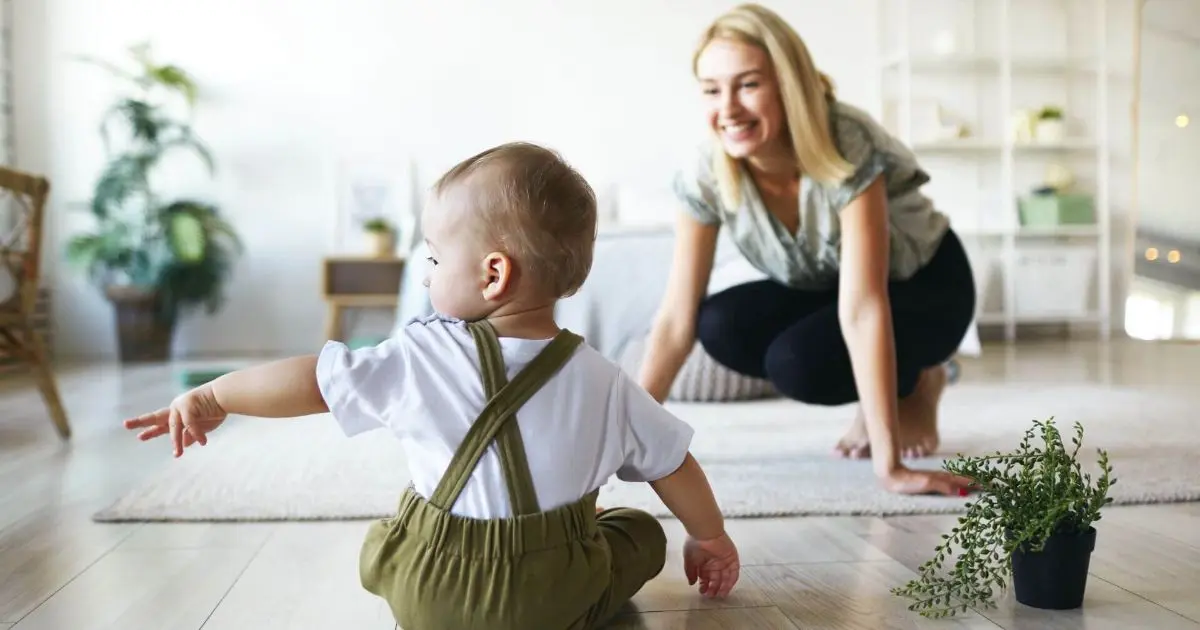
Over time, I realized that the first step was often choosing shared activities that I genuinely enjoy myself. Things like drawing together, building with LEGO, our regular walks — or even working out.
At first, I could only manage movement while wearing my child in a carrier, and later I slowly began to invite them into the exercises with me. That’s when play gradually stopped feeling like self-sacrifice and became a real, shared experience.
The second important realization was this: I don’t have to enjoy every moment of our time together. It doesn’t have to be perfect. Sometimes, simply being with each other is enough.
Presence isn’t always visible or joyful — and yet, it still builds connection.
Setting boundaries matters in this process, but it isn’t the first step. Often, it’s more helpful to start by asking how my child’s needs and my own needs can exist at the same time. Because over time, I came to see that mom guilt often comes from the belief that we have to choose — ourselves or our children.
We don’t. And when I truly understood that for the first time, something inside me finally softened and settled.
Connection, Guilt, and the Idea of the “Good Enough” Mother
For a long time, I believed that taking time for myself was selfish. I don’t see it that way anymore. Time I give to myself isn’t something taken away from my child — it’s protection for our relationship. Because I can only be a patient, truly present parent when I’m not completely depleted.
It also gives my child a sense of safety to see that I don’t disappear from the relationship when I set boundaries. I simply say: “I’m going to rest for a little while, and then I’ll be back and we’ll be together.” What often looks like misbehavior in the morning is really a desire for connection. When my child receives a few minutes of undivided attention at the start of the day — a hug, a short game, a calm conversation — it becomes much easier for them to accept that I’ll later need space and time for myself.
Mom guilt doesn’t fade by silencing our inner voice. It softens when we begin to understand where it comes from. Recognizing the messages we carried from childhood allows us to speak to ourselves differently. For example:
“Not enjoying every minute of play doesn’t make me a bad mom. Connection matters to me — and I’m finding my own way to it.”
Being a good mother isn’t about loving pretend play or enjoying every single moment. It’s about valuing the relationship — while also allowing myself to matter.
This is motherhood too. And it’s more than good enough.
As a closing thought:
👉 Often, what helps the most is realizing that we don’t have to carry everything alone as mothers. When we share the load with our partner and express gratitude for the help, the presence, and the everyday small gestures, something softens. Motherhood isn’t meant to be a solitary role — and it doesn’t have to be one.
As Valentine’s Day approaches, you might find yourself wondering how to celebrate without pressure or expectations, yet still feel connected. If you’re looking for simple, baby-friendly ideas to prepare together — gently, realistically, and with love — you might enjoy this article:
→Top 8 Valentine’s Day Ideas With a Baby for New Parents

A small reminder that your relationship matters, especially in this season of life. 💛
👉If you’d like to walk this journey feeling more prepared, more confident, and a little less worried, visit the Little Lifesavers page and explore our free downloadable resources. They’ll help you stay organized, plan ahead, and create the kind of calm and clarity you need most right now.
👉And if you’re looking for stories and support that speak to the emotional side of motherhood — beyond diagnoses and definitions — you’ll find more honest, real-life reflections in our Motherhood section.