

The Simplest Way to Become the Father Your Child Will Never Forget

If you’re currently expecting a baby, or simply trying to survive those first months with a newborn, chances are everything around you revolves around motherhood. How you give birth, how you breastfeed, how much sleep you’re getting — or more likely, how little. Most advice, articles, and conversations focus almost entirely on moms. Fathers are talked about far less.
And yet, a father’s presence shapes a child’s emotional world, confidence, and future relationships just as deeply. For a long time, even psychology treated fathers like supporting characters. Mothers were seen as the source of safety, attachment, and care, while fathers were often viewed simply as the ones who “help out.” Today, we know that picture was far too simplistic.
A father is not a substitute for a mother. And he’s not just an extra pair of hands for diaper changes or bedtime. He brings something entirely different into a child’s life — a different kind of energy, a different example, and a different sense of security. There are things a father can give that no one else can replace.
A father’s presence matters not because he’s perfect, but because he’s there. He pays attention. He connects. He becomes part of everyday life — from the very beginning.

In the Early Years: Who Is a Father in a Young Child’s Eyes?
During the first three years, a mother’s and father’s roles can seem very similar from the outside. Both of you care for your baby, protect them, and stay by their side through everyday life. But if you look a little closer, there’s often an important difference in how a child connects to each parent. As a mother, you usually become the child’s safe foundation — the emotional base from which they begin exploring the world.
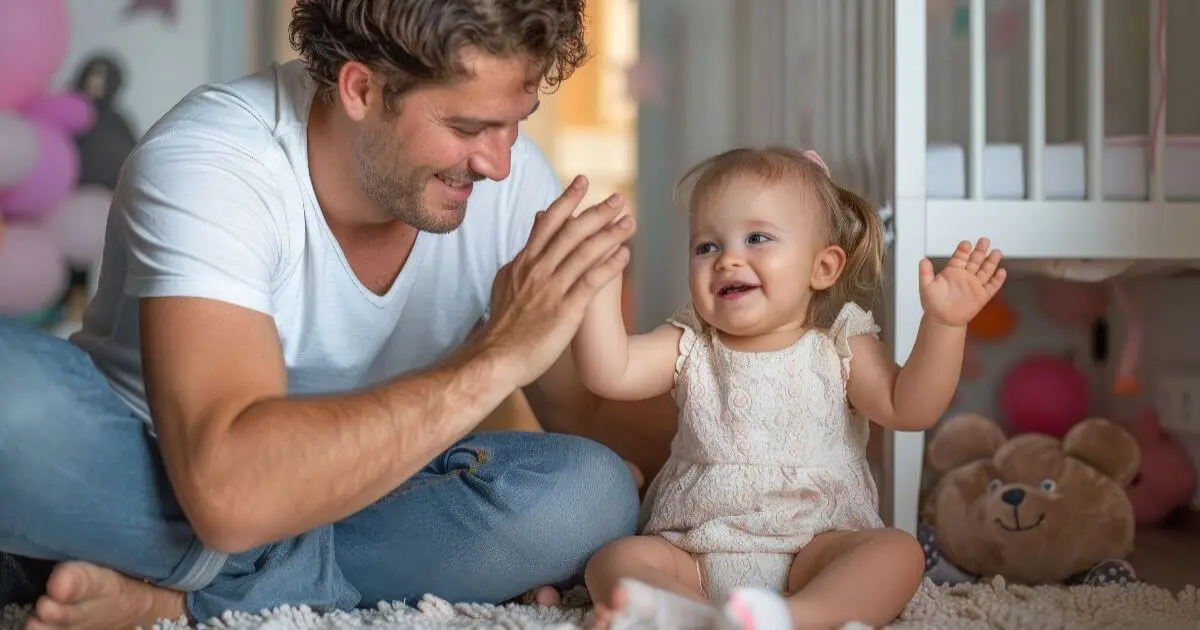
A father, on the other hand, often represents discovery, play, excitement, and movement. He’s the one a child may laugh louder with, take small risks with, and feel encouraged to explore beside. That doesn’t mean a father is less important or less present. Quite the opposite.

He is present in a different way — and that difference matters deeply. A child needs both: the safety of a secure emotional home and the hand that gently encourages them to step into the world with confidence. When parents raise a child as partners — not competing with each other or trying to replace one another — it creates a powerful sense of security.
Children growing up in that kind of environment are often more emotionally balanced and confident later in life. But this also means your relationship matters too. Yes, even in the exhausting newborn stage. A small touch, a kind gesture, the way you speak to each other when your child is watching — these moments quietly shape how your child will someday understand love, trust, and healthy relationships.
👉If you’ve ever felt like your relationship changed after becoming parents, you’re not imagining it. Read Marriage After Baby – When Your Lover Becomes Your Co-Parent and discover why even strong couples can feel disconnected after a baby — and how to find your way back to each other again.

Preschool and School Years: Why a Father Matters So Much
As a child grows, a father’s role changes too — and becomes increasingly important. Preschool-aged boys often become fascinated with their fathers: they imitate them, watch them closely, and copy their behavior. This is the stage when a father can truly lead by example — not through words, but through the way he behaves. How he talks to others, how he handles conflict, how he treats his partner. A child absorbs all of it.
Preschool years are also when separation from the mother begins, and the father plays a key role in this process. If he is present, reliable, and someone the child can depend on too, separation happens much more smoothly. Part of this also means allowing the child to make small, age-appropriate decisions. A child who is overly controlled, and whose decisions are always made by others, can easily become anxious and insecure.
By school age, children actively compare themselves to their parents, test boundaries, and become more interested in the opposite sex. A father remains surprisingly important here too — for girls just as much as for boys. Research shows that girls who grow up without a father are more likely to end up in early or even abusive relationships. Boys, meanwhile, may struggle more to learn initiative and respect for boundaries without their fathers.
A father also represents authority, rules, and structure — and part of learning to accept limits depends on whether there was a reliable adult man in a child’s life.
The Teenage Years: When the Relationship Changes Again
The teenage years are a completely different chapter. Teen girls sometimes unconsciously test their growing attractiveness with their fathers — joking, chatting, or flirting a little. This is completely normal and should not be misunderstood. Within a safe father-child relationship, they are practicing dynamics they will later experience with peers.
Teen boys often engage in power struggles with their fathers and constantly test boundaries. If this stormy period can be navigated successfully, a father can eventually become something truly special in his child’s life: a trusted man they can talk to about serious things too.
What Happens When a Father Isn’t Present?
This is a sensitive topic, and it’s not something that can be viewed in black and white. Growing up “without a father” can mean many very different things. Losing a loving father is not the same as growing up with a father who is physically present but emotionally unavailable — or even abusive. Often, it’s not the physical absence that causes the deepest wounds, but the emotional absence.
When a mother has to carry everything alone, one of the biggest traps is trying to become both parents at once. In the long run, this is exhausting and rarely works well. It’s much healthier when a mother can remain a mother — because from that stable role, she can give her child emotional security more naturally. In these situations, the oldest son often grows up a little faster and takes on more responsibility earlier.
This is not necessarily harmful — as long as he does not have to give up his own childhood completely. What can truly become damaging is when the father becomes a taboo subject. When nobody talks about him, or when shame, anger, and secrets surround his story. A child needs to know their own story. They need to understand where they come from and who their parents are.
When that story is missing, hidden, or distorted, children can easily begin blaming themselves or questioning their own worth — especially after divorce, when many children instinctively believe the family breakup was somehow their fault.
👉 Sometimes the hardest part after having a baby isn’t the sleepless nights — it’s what quietly starts happening between the two of you. Read Relationship After Baby – When the Hardest Part Is No Longer the Baby and discover why so many couples feel disconnected after becoming parents — and how to reconnect before the distance grows bigger.

How Can a Father Be Truly Present?
A good father is not defined by being home every single day at exactly 6 PM. What matters far more is that when he is there, he is truly present — with attention, connection, and genuine involvement.

There are a few things that truly matter:
A father who works a lot is not automatically an absent father. But meaningful time together usually needs to be created intentionally. And yes — quality often matters more than quantity.
A child whose father truly pays attention to them — instead of constantly looking at his phone — grows up feeling important. And that feeling stays with them for years. Fatherhood also does not end when a child grows up. For sons, a father often remains one of the strongest examples of masculinity, strength, and how to move through the world.
Building something together in the garage, going to a soccer game, taking a rafting trip, or even roughhousing at home — these become the memories that last for decades.
For daughters, a father is often the first man they learn to truly trust. A safe, healthy father-daughter relationship can shape how a girl later sees herself, relationships, and emotional safety. That’s why it matters so much from the very beginning that a father is not only physically present — but emotionally available too.
👉And if you’re looking for gentle, real-life guidance beyond milestones — support that sees both your baby and you — you’ll find it on MomLifeStories.
👉If you’d like to walk this journey feeling more prepared, more confident, and a little less worried, visit the Little Lifesavers page and explore our free downloadable resources. They’ll help you stay organized, plan ahead, and create the kind of calm and clarity you need most right now.